Developing modern software for oil & gas well construction
We build accessible, fast, and standalone tools for casing physics calculations and OCTG reference databases. Our goal is algorithmic precision, reliable offline execution, and engineer-first experience.
- Measured depth
- 5297 m
- True vertical depth
- 1900 m
- Inclination
- 90.0°
- Dogleg severity
- 0.00 °/30 m
Our Mission & Approach
The Hadalbore project was born out of direct practical experience in oil & gas well construction. We do not attempt to compete with massive legacy corporate suites — we build accessible, fast, and transparent tools that solve specific field engineering challenges without bureaucracy.
An engineer on a well pad or drilling rig often operates far beyond stable connectivity. Accessing API 5CT pipe tolerances or running string mechanics should be as simple and instantaneous as opening a calculator — 100% offline, local, and zero-wait.
We are actively evolving and refining our platform step by step: from the HADALBORE_LAB offline reference environment to new physical solvers. Our core priority is algorithmic precision, robust offline execution, and creating software engineers truly enjoy using every day.
Tools Architecture
We are building a unified ecosystem of standalone engineering products for well construction — from reference databases to specialized calculation modules.
HADALBORE_LAB (Free)
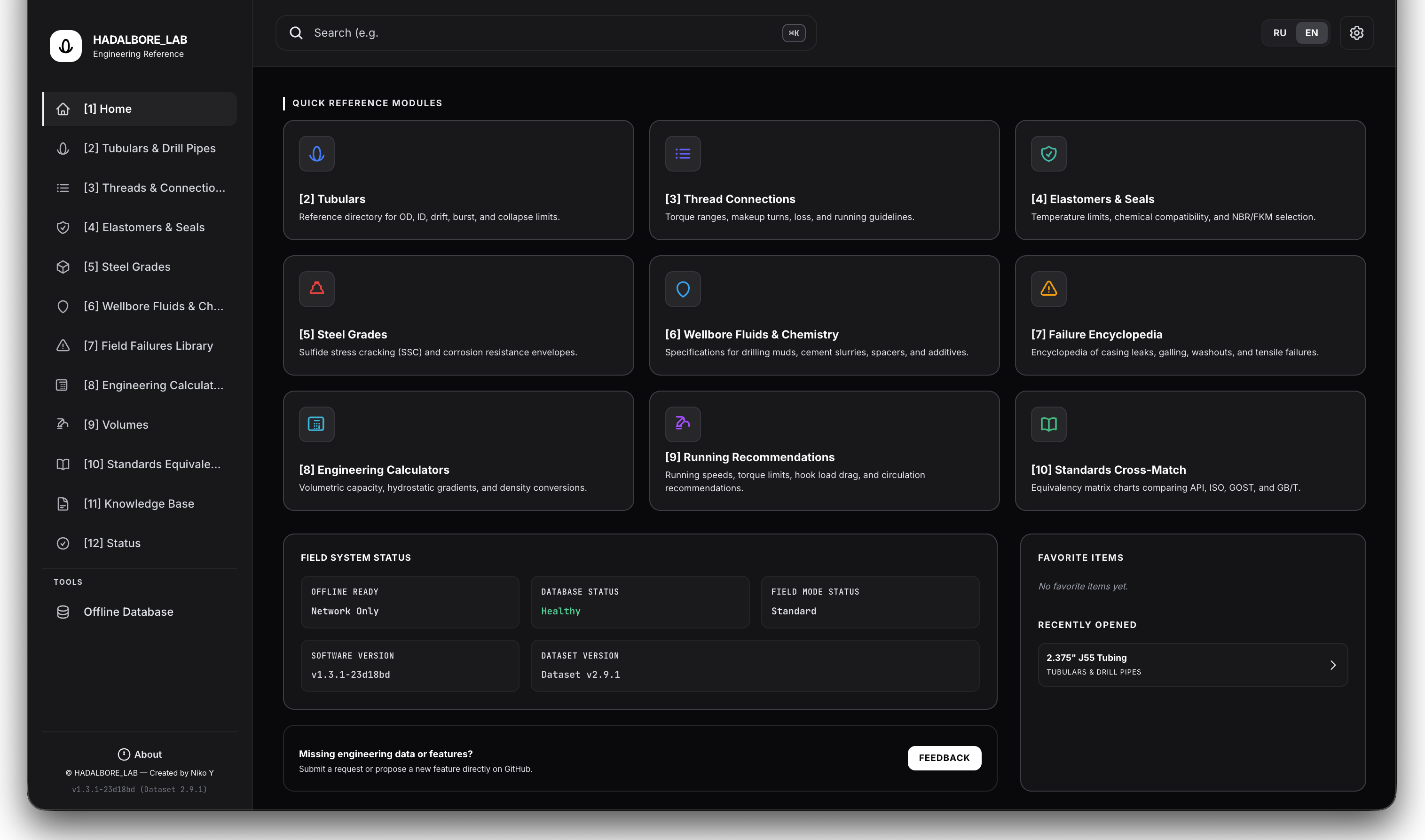
Autonomous offline reference catalog and engineering lab for OCTG casing & tubing parameters (API 5CT / ISO 11960). Instant search of geometry, strength properties, and thread tolerances — no internet connection required. Runs in any modern browser on PC, tablet, or smartphone — no installation, no registration.
- Expandable API 5CT & ISO 11960 Casing Catalog
- Thread Connections Reference Database
- Metallurgy Selection per NACE MR0175 (H2S / CO2)
- Makeup Torque Reference & Specifications
- Thermal Expansion & Corrosion Resistance Checks
- Drilling Fluids & Inhibitors Compatibility
HADALBORE (T&D)
Full-featured native desktop application for macOS & Windows. Engineering suite for casing & drillpipe running simulation with 3D geology, production logging, risk point detection, and friction modeling. Access is tied to user account registration.
- Torque & Drag Calculation Engine (T&D)
- Dynamic Casing Running Simulation (Slack-off / Pick-up / Rotating)
- 3D Geology & Production Logging (PLT/WLS) Integration
- Automated Hazard & Risk Point Detection (Sticking, Washout, DLS)
- Buckling & Physical Lock-up Threshold Control
- 3D Friction Factor Back-Calculation & Calibration
- Centralizer Placement & Standoff % Optimization
- Surge & Swab Hydrodynamic Pressure Waves
- Engineering Report Exports & Stress Visualizers (PDF / XLSX)
HADALBORE CIC
Casing Integrity Control & structural analysis engine. Computes triaxial Von Mises equivalent stresses, models Maximum Allowable Internal Pressures (MAIP), accounts for cement sheath elasticity, and evaluates sour service metallurgy (H2S / CO2).
- Internal yield (Barlow burst) & API 5C3 4-zone collapse calculations
- Triaxial Von Mises stress evaluation with thermal expansion loads
- 3-layer thick-walled cylinder model for cement sheath pressure shielding
- Maximum Allowable Internal Pressure (MAIP) & annular fluid balance
- Sour service metallurgy verification & H2S/CO2 checks (NACE MR0175)
Offline operation
Core reference and calculation workflows are designed for rigs, field offices, and remote locations without dependable network access.
Verified inputs
The interface keeps formulas, standards, and assumptions visible so engineering decisions can be checked before use.
Operational speed
Common lookups and planning steps are kept short, dense, and repeatable for field conditions.